library(hemispheR)Loading required package: terraterra 1.9.11このノートでは、魚眼レンズや全天球カメラで撮影した林内写真から、 「空がどれくらい見えているか(= 樹冠開空度)」を数値化する方法を紹介します。
「魚眼レンズや全天球カメラで撮影した林内写真」は、専門的にはDigital Hemispherical Photography (DHP)と呼ばれます
hemispheR を使って解析します (Chianucci and Macek 2023)参考リンク:
# renvを使用している場合
renv::install("gitlab::fchianucci/hemispheR")

# CRANからインストールする場合
install.packages("hemispheR")

# 開発版をインストールする場合
# install.packages("devtools")
devtools::install_git("https://gitlab.com/fchianucci/hemispheR")library(hemispheR)Loading required package: terraterra 1.9.11image_path <- "data/dhp_example_19rinpan1_2.jpg"
img <- terra::rast(image_path)Warning: [rast] unknown extentterra::plotRGB(img) # 元画像を表示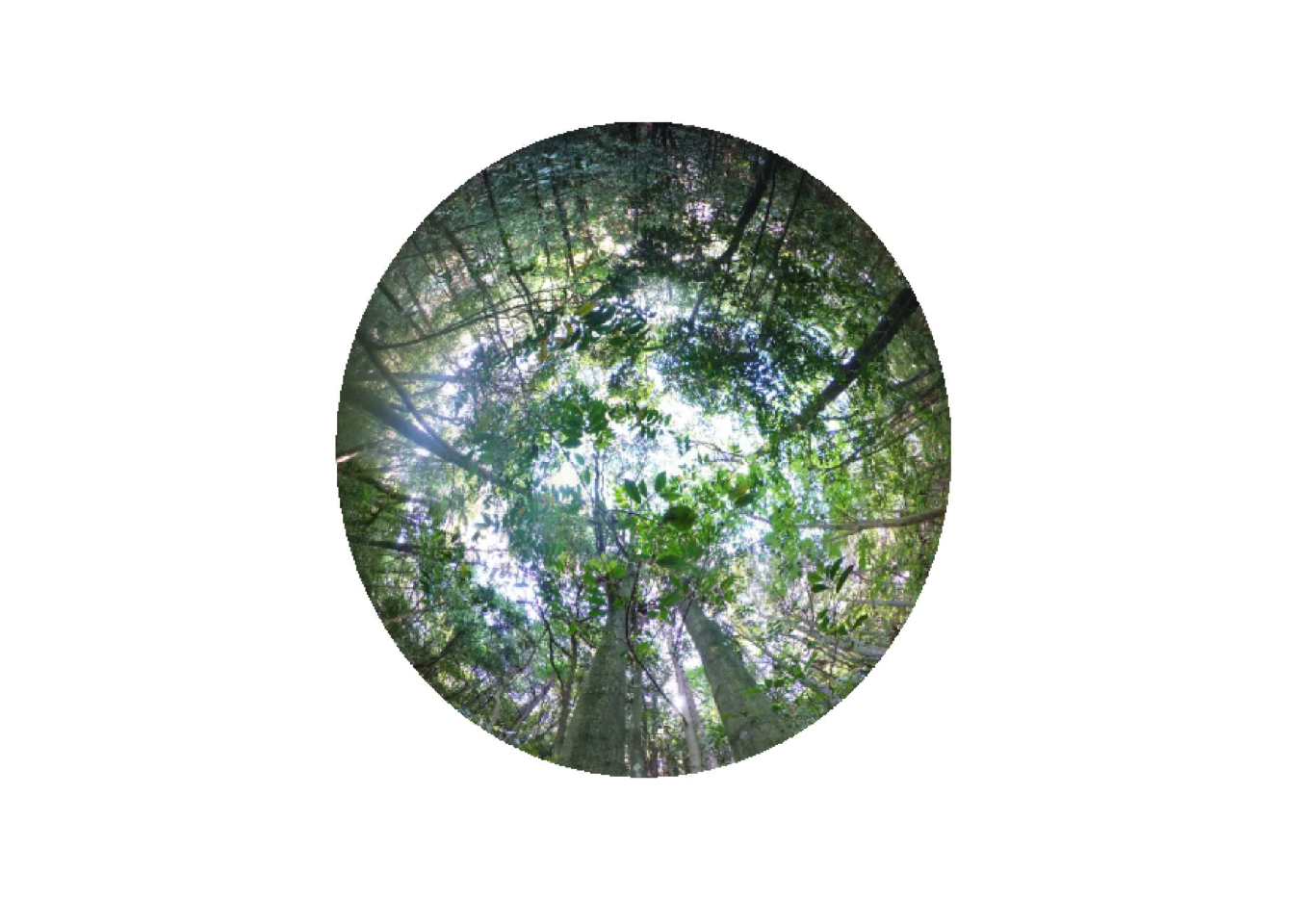
hemispheR::import_fisheye() で、 「どこが魚眼画像の中心か」「どこまでを解析対象にするか(半径)」を指定します。
xc <- dim(img)[2] / 2 # 画像幅の半分
yc <- dim(img)[1] / 2 # 画像高さの半分
rc <- 550 # 解析に使う半径(画像に応じて調整)

image_fisheye <- import_fisheye(
  image_path,
  channel = 3,
  circ.mask = list(xc = xc, yc = yc, rc = rc),
  circular = TRUE,
  gamma = 2.2,
  stretch = FALSE,
  display = TRUE,
  message = TRUE
)
It is a circular fisheye, where xc, yc and radius are 1024, 786, 550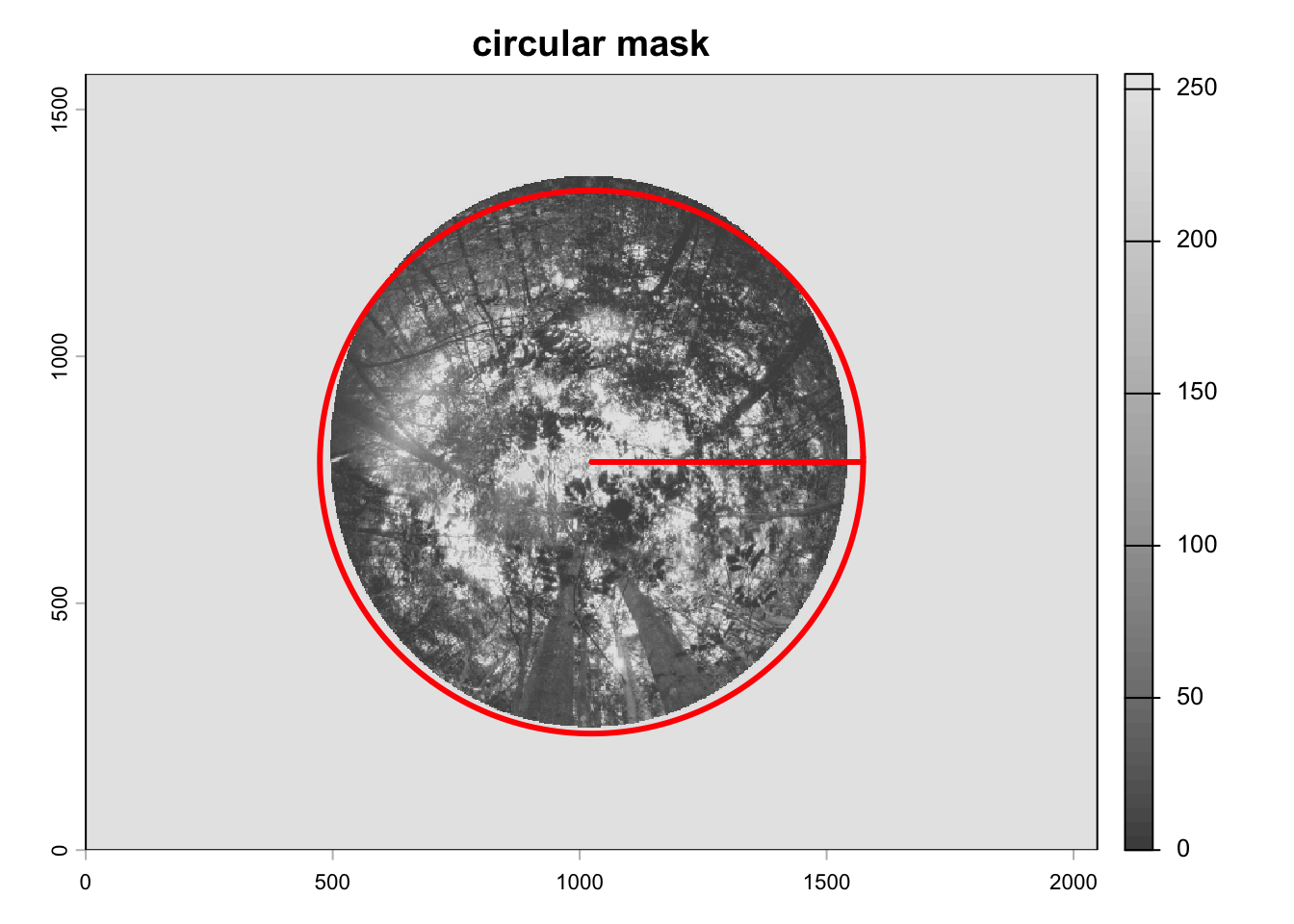
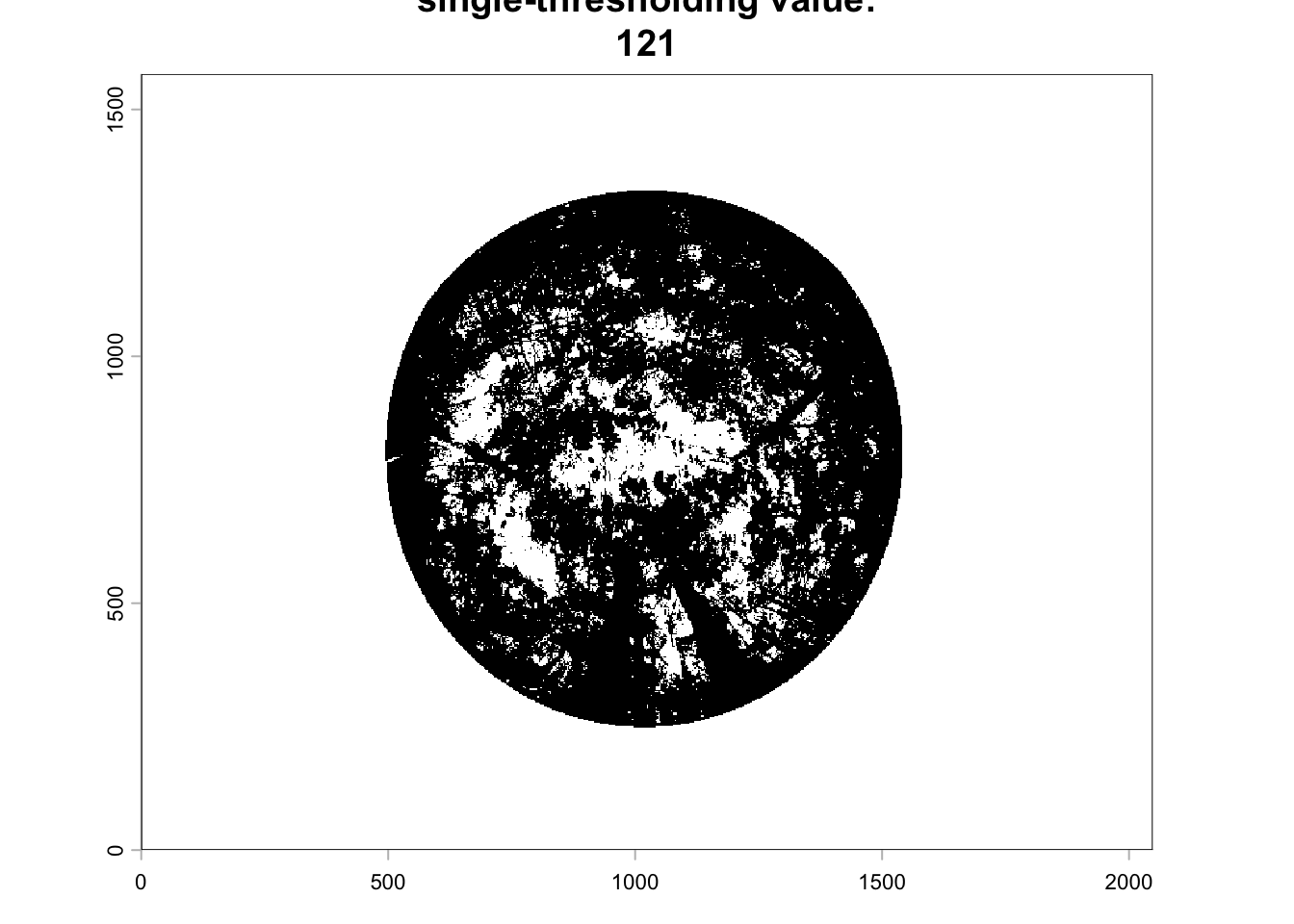
hemispheR::binarize_fisheye() で、画像を「空(白)」と「樹冠(黒)」に分けます。 ここでは自動しきい値法の Otsu 法を使います。
img_binary <- binarize_fisheye(
  image_fisheye,
  method = "Otsu",
  zonal = FALSE,
  manual = NULL,
  display = TRUE,
  export = FALSE
)
gap_frac <- gapfrac_fisheye(
  img_binary,
  maxVZA = 90,
  lens = "equidistant", # デフォルト
  startVZA = 0,
  endVZA = 70,
  nrings = 7,
  nseg = 8,
  display = TRUE,
  message = FALSE
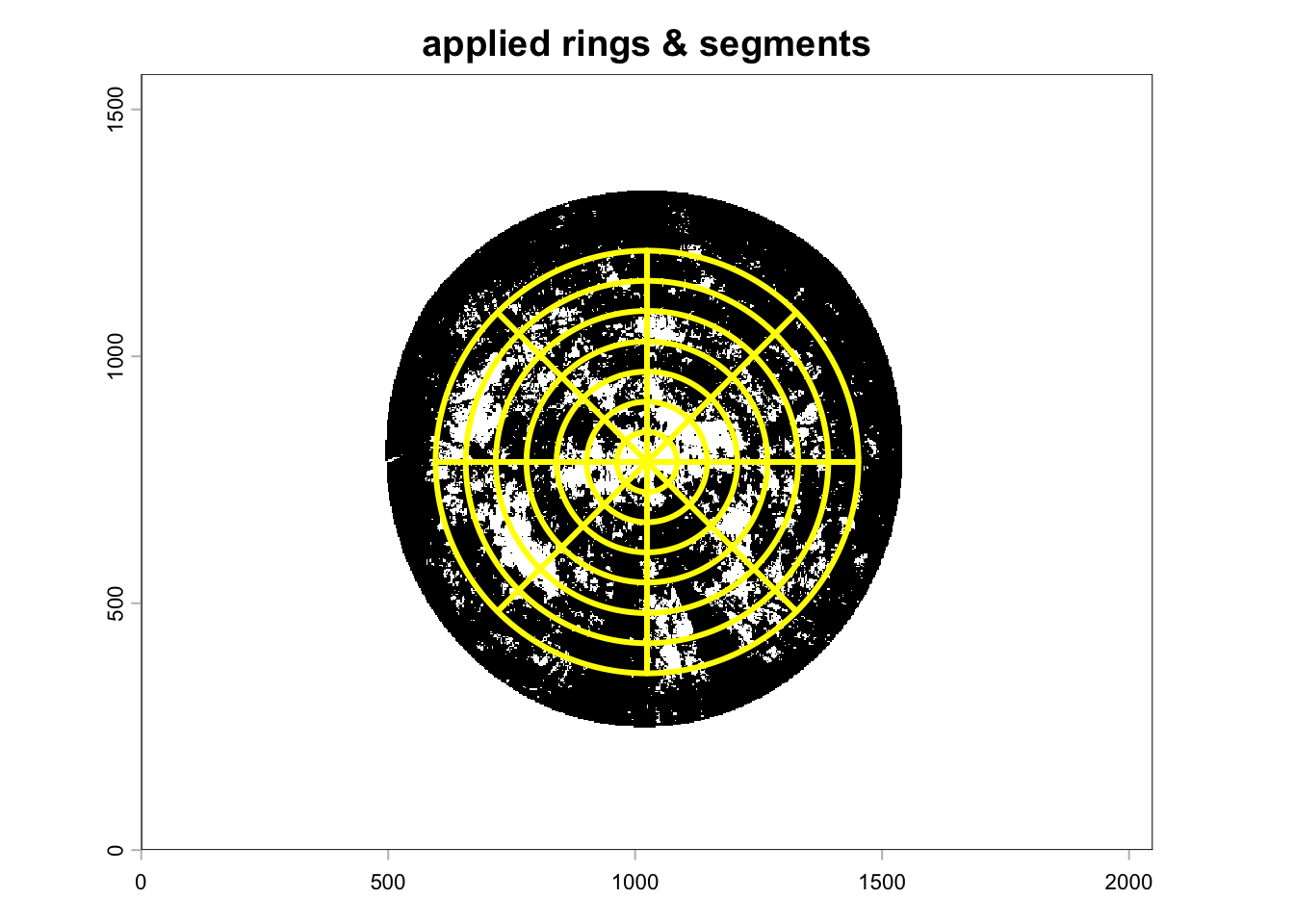
)
canopy <- canopy_fisheye(gap_frac)
canopy
# A tibble: 1 × 20
id Le L LX LXG1 LXG2 DIFN MTA.ell x VZA rings azimuths
<chr> <dbl> <dbl> <dbl> <dbl> <dbl> <dbl> <dbl> <dbl> <chr> <int> <int>
1 dhp_ex… 1.69 1.94 0.87 0.66 0.53 30.5 57 1.05 5_15… 7 8
# ℹ 8 more variables: mask <chr>, lens <chr>, channel <chr>, stretch <chr>,
# gamma <chr>, zonal <chr>, method <chr>, thd <chr>この出力に含まれる代表値のひとつが DIFN です。 DIFN(diffuse non-interceptance)は、 「拡散光が樹冠に遮られずに通る割合」を表す指標です。