SAM Particle Counter
Japanese version is available here: SAM Particle Counter マニュアル(日本語版)
Introduction
Welcome to the SAM Particle Counter manual.
This page is the English manual describing the analysis workflow, from image loading to exporting particle count results.
What this app can do
SAM Particle Counter is a napari based desktop tool that supports the following tasks:
- Creating a rectangular ROI (region of interest)
- Automatic segmentation with SAM2
- Refinement by point prompts and label editing
- Exporting overlay images, CSV files, and run metadata
The typical workflow is as follows:
- Load an image
- Draw an ROI
- Crop to the ROI
- Run SAM2 auto segmentation
- Refine the result if needed
- Export artifacts
Prerequisites
Environment setup
For detailed setup instructions, see README.md. At minimum, ensure the following:
- Dependencies have been installed with
uv - The SAM2 setup script for your OS has been executed
- The app can be started with the following command
Terminal
uv run main.pyTo stabilize segmentation quality, the following is recommended:
- Images with sufficient contrast between particles and background
- Images with minimal strong blur or compression noise
Detailed analysis procedure
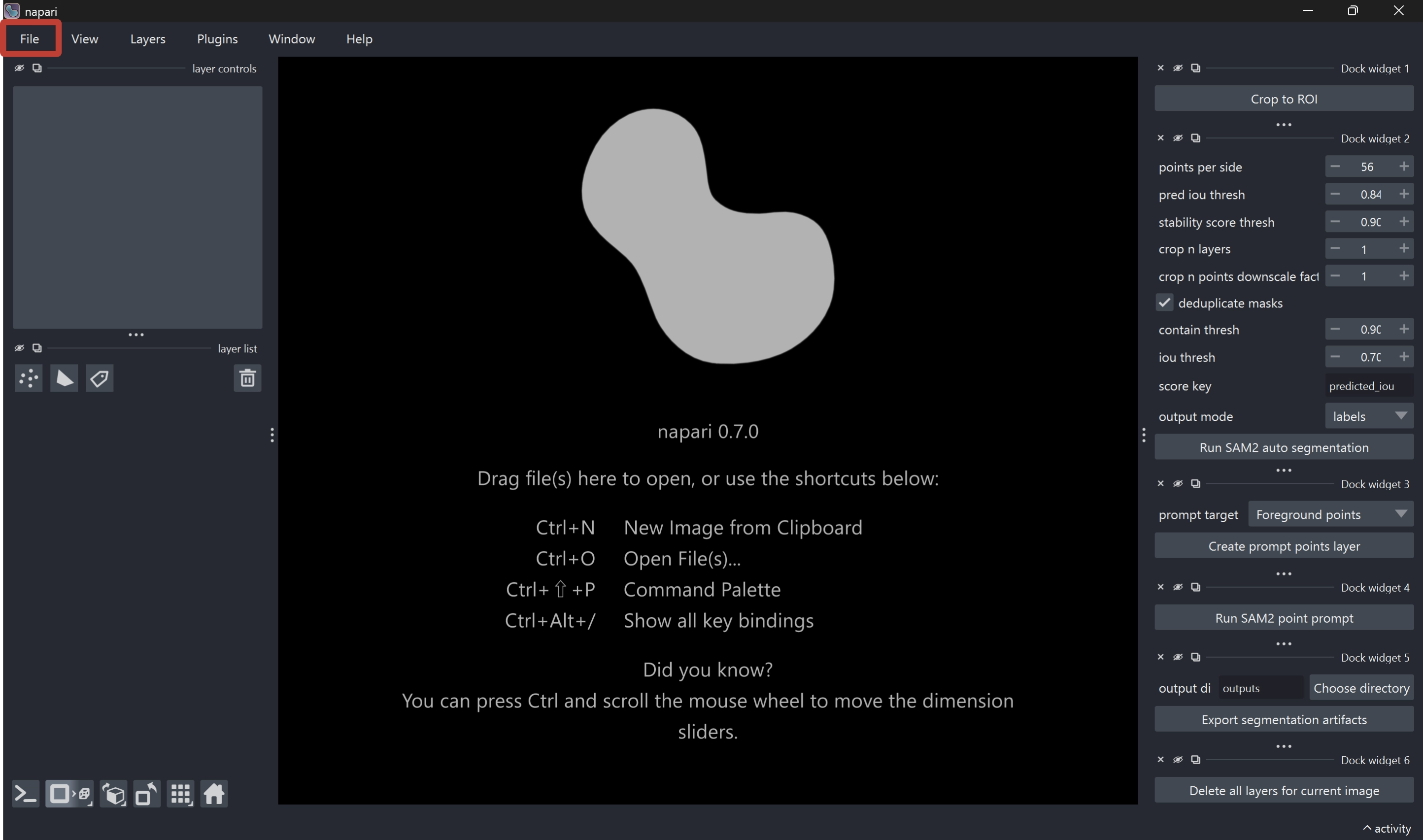
Step 1. Load an image
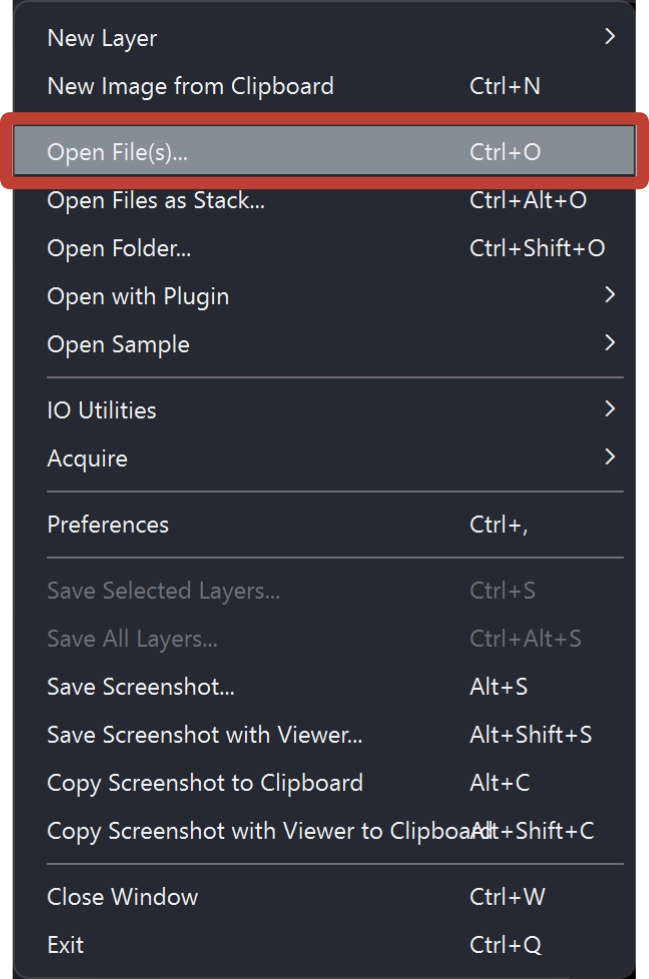
Load an image into napari (drag and drop, or File > Open...).
When the first image layer is added, the corresponding ROI (region of interest) layer (<image_name>_ROI) is created automatically.
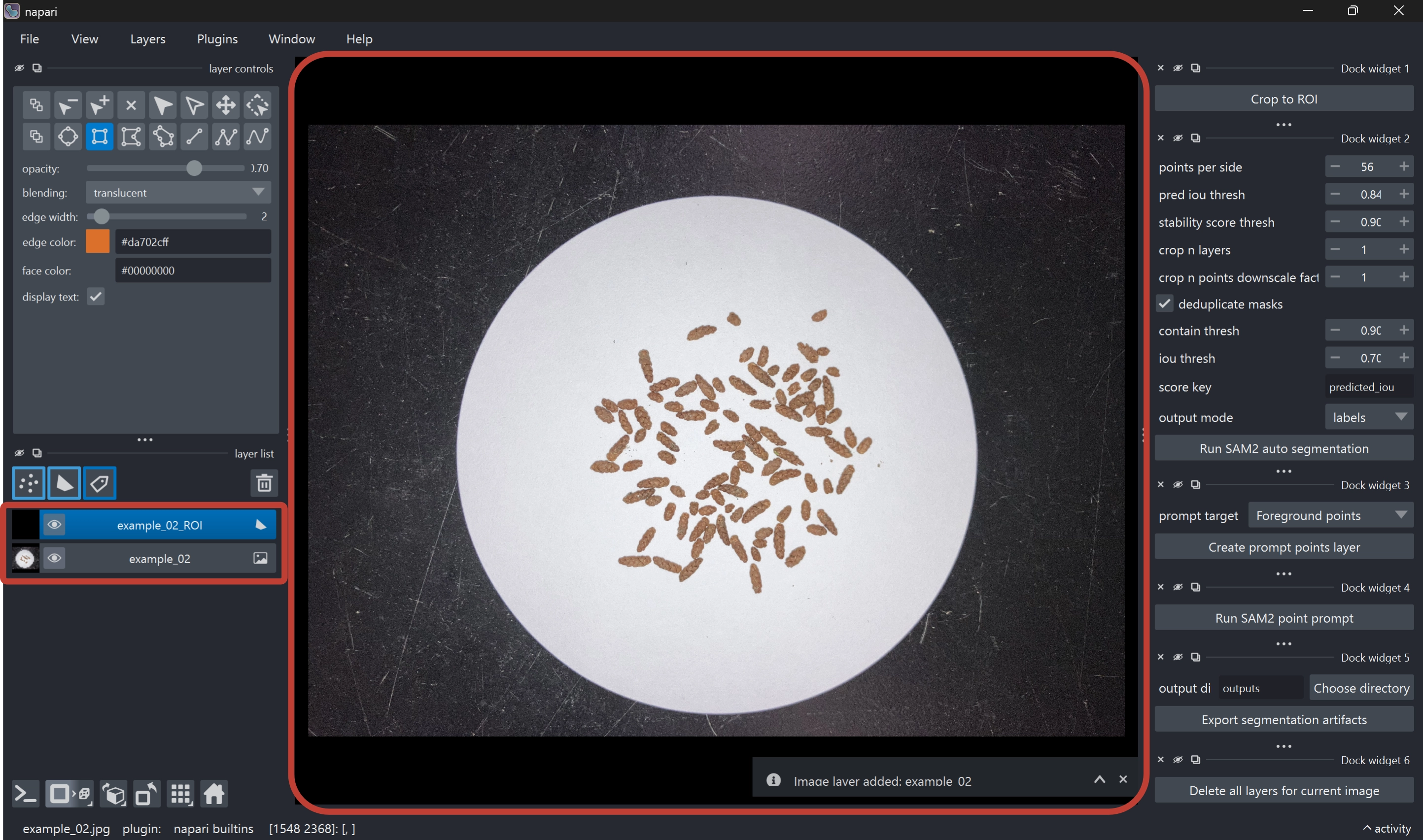
This app resolves processing targets using layer naming conventions. Please do not manually rename layers.
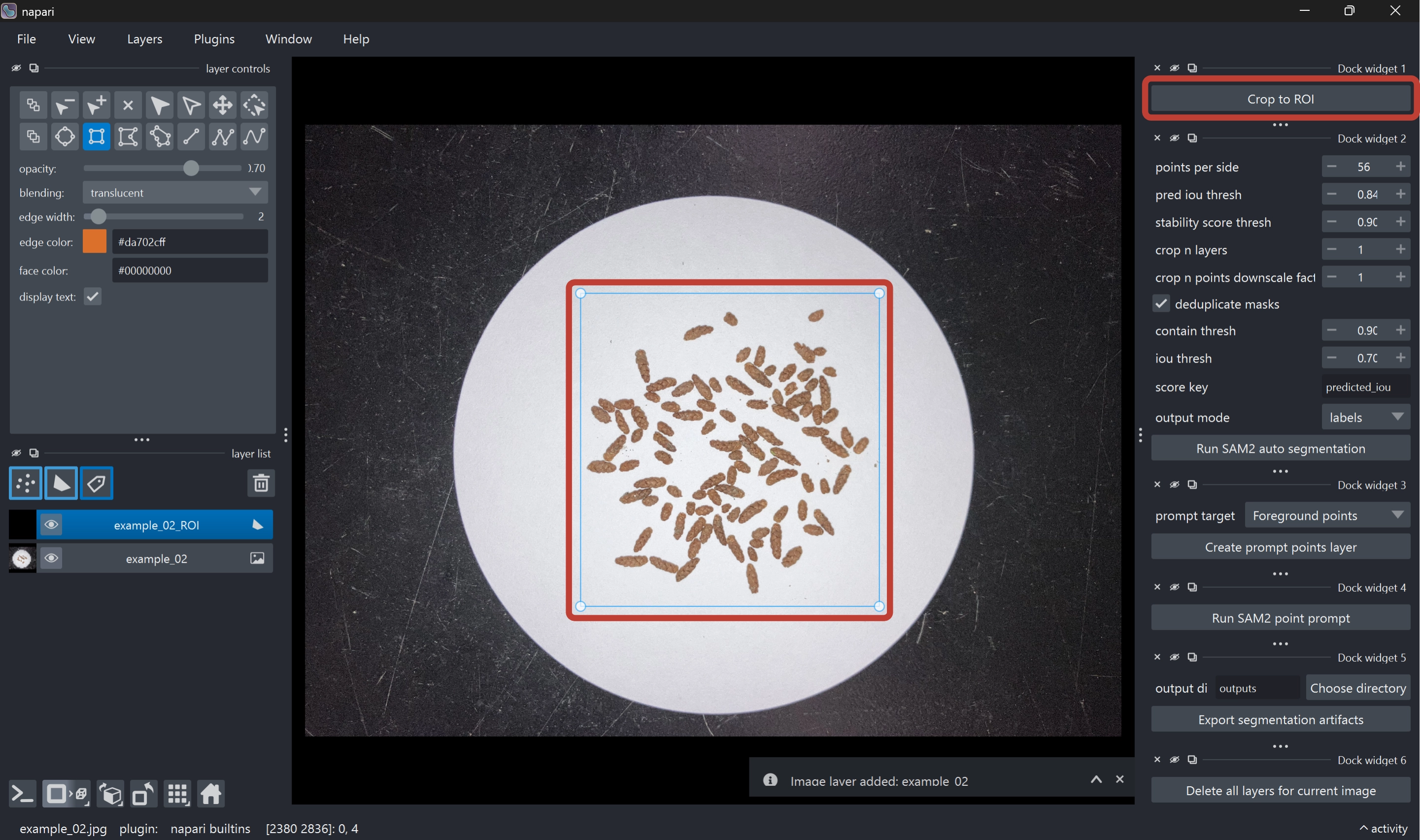
Step 2. Draw ROI on the *_ROI layer
- Select the ROI layer (
<image_name>_ROI) (selected by default) - Draw a rectangle with the Add Rectangles tool
 (selected by default)
 - If multiple ROIs exist, the last rectangle drawn is used
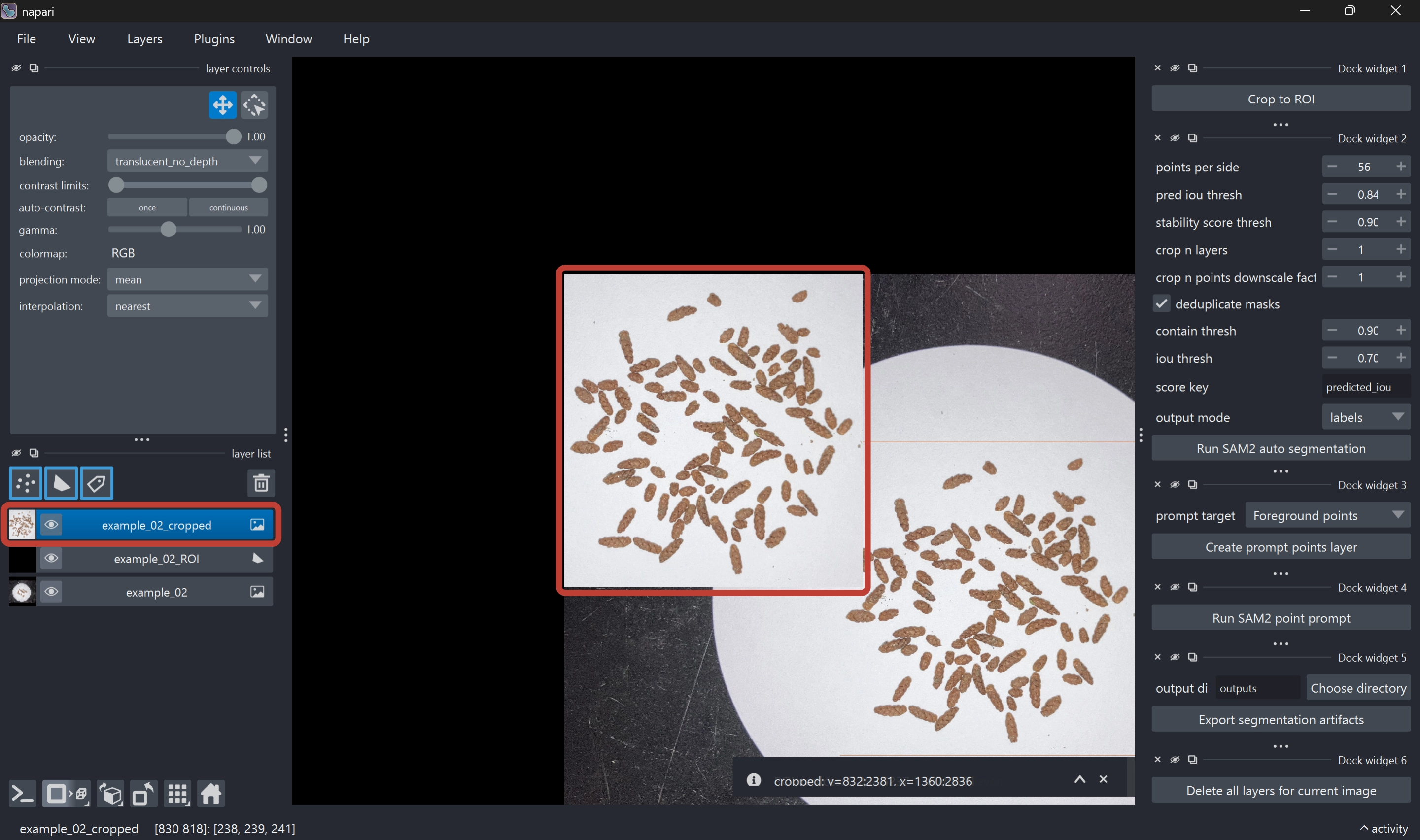
- Run the Crop to ROI button in the right-side widget
- An
<image_name>_croppedlayer is created, and the ROI region is cropped from the source image
- Leave a small margin so target particles are not missed
- Exclude irrelevant regions as much as possible
- If processing is heavy, start from a smaller ROI
- You can pan the view by dragging while holding the space key
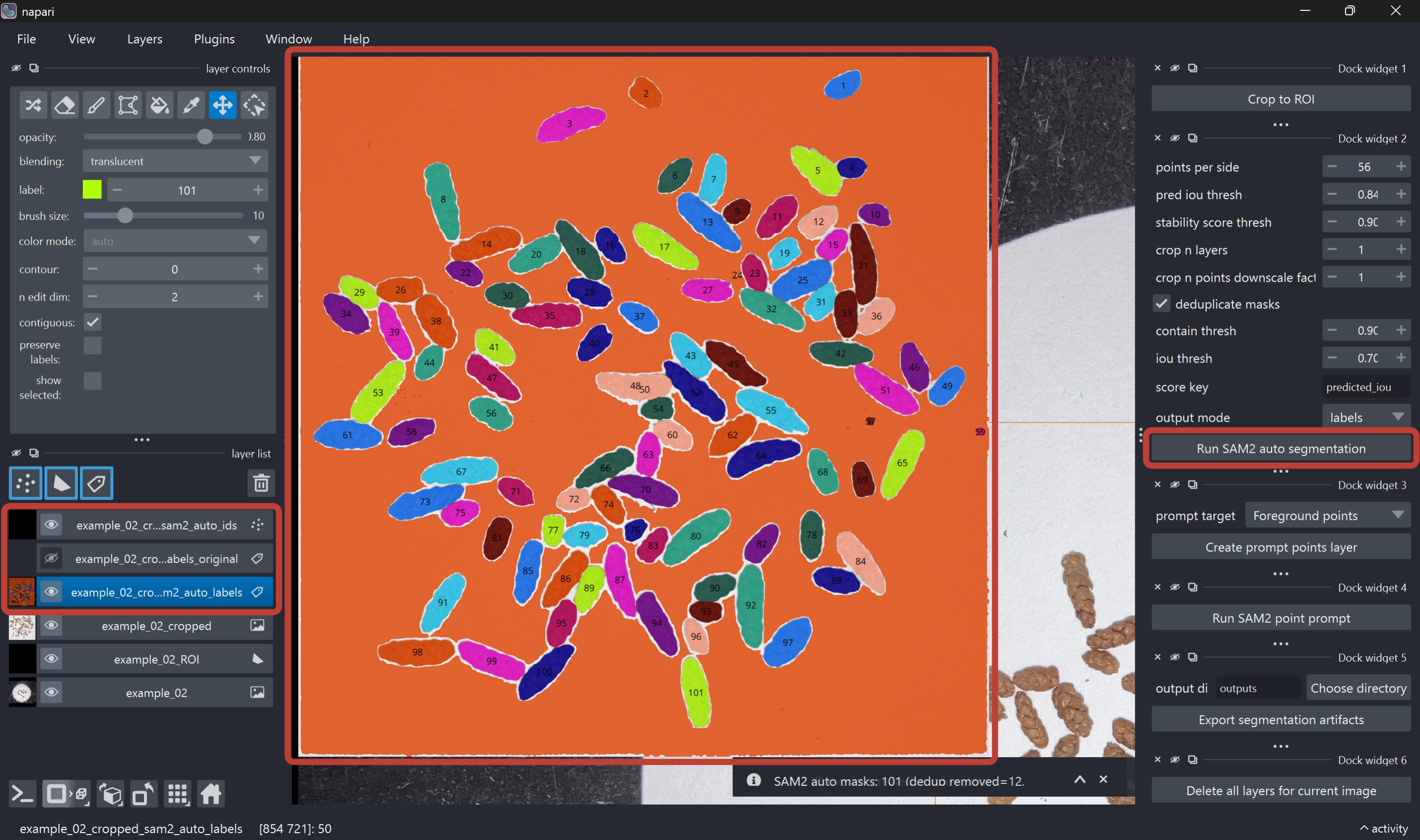
Step 3. Run Run SAM2 auto segmentation
- Select the
<image_name>_croppedlayer (selected by default) - Run the Run SAM2 auto segmentation button in the right-side widget (adjust parameters as needed)
- SAM2 segmentation results are output as new layers:
<image_name>_cropped_sam2_auto(polygons)<image_name>_cropped_sam2_auto_labels(editable labels)<image_name>_cropped_sam2_auto_labels_original(read-only reference copy)- Overlay showing label IDs (do not edit)
SAM2 parameters
| Parameter | Description | Default (recommended) |
|---|---|---|
points_per_side |
Specifies the density of automatic prompt points placed across the image. Increasing this value enables finer exploration and improves detection of small particles, but increases processing time and memory usage. | 56 |
pred iou thresh |
Threshold for SAM2’s predicted mask quality score. Higher values keep only more confident masks and tend to reduce false positives, but may increase missed detections. | 0.84 |
stability score thresh |
Threshold for mask stability score. Higher values keep only masks with more stable boundaries. Particles with unstable contours or very small particles may be filtered out. | 0.90 |
crop n layers |
Number of iterative crop-and-reprocess passes. Increasing this value can improve local mask detection, but increases processing time. | 2 |
crop n points downscale factor |
Scaling factor for prompt point density within crop regions. Higher values reduce point density in crop regions and lighten processing, but may reduce sensitivity for small targets. | 1 |
deduplicate masks |
Enables removal of duplicate masks. When enabled, duplicate masks generated for the same particle are removed. For details, see the duplicate mask removal appendix. | True |
contain thresh |
Defines how much one mask must be contained in another to be treated as a duplicate. Lower values make duplicate detection less strict and can remove more masks. Higher values remove masks only when one is almost fully contained in another. | 0.90 |
iou thresh |
IoU (Intersection over Union) threshold for overlap between two masks. Lower values make partially overlapping masks more likely to be removed as duplicates. Higher values remove only strongly overlapping masks. | 0.70 |
score key |
Score used to decide which duplicate mask to keep. Typically use predicted_iou to retain the higher-quality mask. |
predicted_iou |
output mode |
Specifies the output format for SAM2 results.
|
labels |
Step 4. Manual refinement (optional)
Refine results as needed to improve final count accuracy.
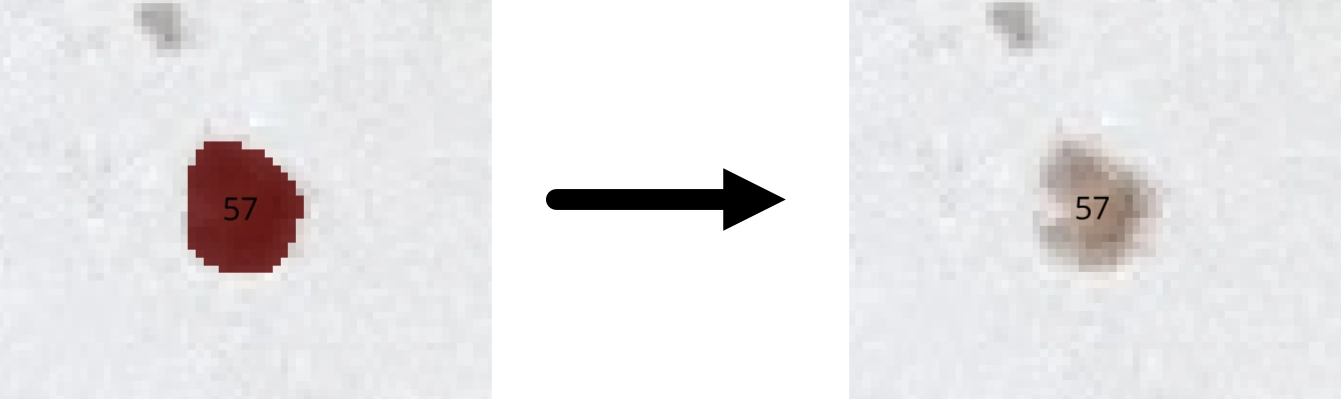
(A) Manual label editing
- Select the
<image_name>_cropped_sam2_auto_labelslayer (selected by default) - Edit labels using napari label editing tools
For basic label editing operations, see the official napari documentation.
When you want to add particles
If particles were missed, increase the label number in the upper-left panel by one, then draw a new particle mask using the paint tool  . You can adjust brush thickness via brush size.
When you want to split particles
If multiple particles are connected, erase one side with the eraser tool  , then increase the label number and repaint a new particle mask.
When you want to erase a wide area
If background is falsely detected as a mask, click an empty area with the picker tool  to select background, then click the background mask with fill tool
  to erase in bulk.
Similarly, to erase particles in chunks, pick the particle color with the picker tool and then click that particle with fill tool to erase in bulk.
When you want to remove falsely detected particles
If noise (e.g., dust) is falsely detected as particles, erase it with the eraser tool .
When you want to inspect mask by mask
Enable show selected to display only the selected label ID mask. While this is enabled, changing label lets you inspect masks one by one.
(B) Point-prompt refinement
- Run Create prompt points layer
- Select Foreground / Background
- Place points on the cropped image
- Run Run SAM2 point prompt
Candidate polygons are output to the *_sam2_points layer and can be used to guide refinement.
This feature is currently experimental and may not behave stably in all cases. It often does not work well for very small particles, so regular manual editing is usually more reliable. Please note that this feature is likely to change in future updates.
Step 5. Export results
- After manual editing is complete, run Export segmentation artifacts to export outputs. The output directory defaults to
./outputs, but you can choose any location. The output directory is created automatically. - When export completes, a timestamped folder such as
example_02_20260426T044227Zis generated.
The exported folder includes the following files:
| Filename | Description |
|---|---|
source_with_roi.png |
Source image with ROI box overlay |
cropped_image.png |
Cropped analysis region image |
sam2_only_overlay.png |
Overlay image of SAM2 auto segmentation result |
final_overlay.png |
Overlay image of the final adopted labels |
sam2_blobs.csv |
Particle mask data based on SAM2 auto segmentation result |
final_blobs.csv |
Particle mask data based on the final adopted labels |
run_metadata.json |
JSON file summarizing run parameters, counts, and environment information |
Step 6. Delete layers
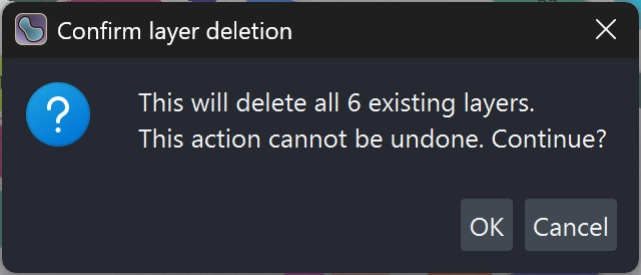
After export is complete, run Delete all layers for current image to remove all layers currently loaded in the viewer (not only the current image). A confirmation dialog appears, but this operation can discard unrelated in-progress work, so use it with care.
Once all layers are deleted, you are ready to load the next image. Return to Step 1 and load the next image.
QA checklist
Before accepting final results, check at least the following:
- ROI includes required regions without major over/under coverage
- Mask boundaries are reasonable at representative locations
- Major merge/split errors have been corrected
- Overlay display and CSV row counts are consistent
run_metadata.jsonis saved together with image artifacts
Troubleshooting
Cropped layer is not created
- Confirm the active layer is
*_ROI - Confirm a valid rectangular ROI has been drawn
SAM2 auto segmentation fails
- Recheck SAM2 setup and model placement
- Retry with a smaller ROI
- Retry with a lower
points_per_side
Export fails
- Confirm a
*_croppedlayer exists - Confirm a SAM2 label layer exists
- Confirm write permission for the output directory
Icon Credits
Some interface icons used in this manual (fill.svg, paint.svg, erase.svg, picker.svg, and rectangle.svg) are copied and/or adapted from the napari project.
Canonical source: src/napari/resources/icons @ c3e6c4ab549eaeb67c6f98502851dd99e4804522. These icon files are copyright (c) Napari and/or napari contributors and are redistributed under the BSD 3-Clause License. See LICENSES/napari-BSD-3-Clause.txt for the full license text.